Research
Science and Technology for the Benefit of Society
By advancing knowledge, driving innovation, and sharing insights with society, universities play a key role in shaping a more sustainable future. At RWTH, the sustainability strategy aims to embed sustainability more systematically in research and knowledge transfer, while expanding support for researchers who want to integrate sustainability into their work.
The strategy also focuses on building a reliable data foundation to track and evaluate sustainability-related activities. At the same time, the university is strengthening support for sustainability-driven spin-offs and incorporating sustainability into the long-term development of its research profile. On a practical level, efforts are underway to make better shared use of research infrastructure, including equipment.
This section highlights current developments in sustainability-related research at RWTH. For more detailed information on objectives, measures, and priority areas through 2030, please refer to the Research focus area of the Sustainability Strategy on the University website.
Good to know: RWTH has a Sustainability Strategy
The Sustainability Strategy outlines the University’s overarching goals through 2030, spanning teaching and learning, research, governance, and operations.
Sustainability in Research
Where do we stand?
As part of its sustainability strategy, the University has defined 10 goals for the Research focus area, supported by 22 measures and 14 performance indicators to monitor progress. Two of these goals are set for completion by 2025, five by 2028, and three by 2030.
As of the reporting date (March 2025), four of the 22 measures have been completed. This includes measures that have been fully implemented and are now part of ongoing practice. More than 80 percent of all measures are at least in the planning stage, and just over 50 percent are already being implemented or have been completed. None of the research-related sustainability goals has been achieved yet. Progress is reviewed through annual status updates. As a result, there may be slight differences between the current state of implementation and the information presented here.


For a more detailed view, see the Measures and Indicators Report. It provides a comprehensive overview of all measures and the performance indicators used to assess progress toward the defined goals.
Sustainability is not an afterthought—it reflects our vision of a livable future and a resilient, competitive economy. Rather than creating additional costs, it helps shape a more robust economy and society. Universities are at the core of this innovation- and knowledge-based system.
At RWTH, interdisciplinary and transdisciplinary research is opening up new approaches to sustainable knowledge creation. We are developing innovative solutions while making our research processes more sustainable. Collaboration, participation, openness, and diversity are central to our success. Our best-practice examples show what can be achieved and encourage us to continue advancing sustainability together. We invite you to be part of this effort.
At a Glance
RWTH’s research also leaves its environmental handprint on sustainable development. This is reflected both in publication output related to the Sustainable Development Goals (SDGs) and in the commitment and activities of University members.


From RWTH to Society
Sustainability in Everyday Research
Contributing to the sustainable transformation of society through research is a central priority for RWTH. This can take many forms, including addressing concrete sustainability challenges through innovations that can be applied in practice and support more sustainable resource use through improved processes and methods.
Addressing complex challenges such as climate change requires collaboration across disciplines. RWTH therefore aims to strengthen interdisciplinary research by bringing together expertise from different fields. This is reflected in the University’s Profile Areas, where researchers work jointly on key societal challenges: “In the Profile Areas, researchers from different disciplines pool their expertise to develop solutions to pressing societal issues.” (Further information: RWTH Profile Areas)
Equally important is a transdisciplinary approach that extends beyond research and academia. By involving stakeholders from outside the University—such as local communities, practitioners, and policymakers—research can better reflect real-world needs and constraints. Professor Frank Lohrberg, from the Institute of Landscape Architecture and spokesperson for the Built and Lived Environment Profile Area, emphasizes the value of this approach. In his research on the urban forest of the future, for example, involving local stakeholders helps build a more complete understanding of the challenges and leads to solutions that are closer to practice.
In the video, Professor Lohrberg shares insights into how sustainability shapes his research. Watch the video and read on to learn more about our progress in this area.
Sustainability is addressed by a range of frameworks. RWTH's Sustainability Strategy, adopted in December 2023, provides the central framework for integrating sustainability across the University, including in research. It is tailored to the University’s specific context while also aligning with these broader frameworks. At the global level, the United Nations’ Sustainable Development Goals (SDGs) serve as a common reference point for classifying sustainability-related activities. Many projects at RWTH align with these goals. Professor Lohrberg’s work, for instance, contributes to SDG 11—Sustainable Cities and Communities. His research on urban agriculture, green infrastructure, and cultural heritage focuses on making cities and communities more inclusive, resilient, and sustainable.
An overview of RWTH’s research contributions to the SDGs based on publication data can be found here.
To further strengthen the integration of sustainability into research, RWTH is expanding its support services for researchers. One example is the “Sustainability in Brief” workshop, now part of the Doctoral Academy’s program. It introduces doctoral candidates to sustainability-related topics and activities at RWTH and raises awareness of how sustainability can be embedded in their work.
In addition, the Sustainability Staff Unit participates in the annual RWTH Young Academics Day, providing information on support structures and funding opportunities for doctoral candidates and postdocs. Another focus is the shared use of research infrastructure. The University has conducted a pilot project to catalogue existing research infrastructure within one faculty using a dedicated tool. The aim is a broader roll-out to enable the most synergistic possible use of research infrastructure across the University.
Sustainability in research at RWTH builds on many starting points. As with most sustainability efforts, progress depends on the active involvement of the University community. At the same time, sustainability is not new to RWTH’s research landscape. Numerous initiatives across the Faculties and Profile Areas already address sustainability-related questions. These efforts are increasingly being embedded at a structural level—for example, through the integration of sustainability into the University’s Development Plan.
Green Facades
Measuring their Environmental Benefit

Green roofs and planted facades have become a familiar feature in urban planning and construction — and their benefits are considerable, not least in relation to climate change and the measures needed to address it.
Research Contribution to the SDGs
RWTH Advances Sustainability Through Cutting-Edge Research
Sustainability in research takes different forms at RWTH—from dedicated sustainability research and work on social responsibility to research that directly supports sustainable development.
One way to capture this contribution is through an analysis of publication data linked to the Sustainable Development Goals (SDGs). As in previous sustainability reports, the University Library analyzed publication data for the period 2023 to 2024. Using predefined search queries to ensure comparability, Elsevier’s SciVal analysis tool enables publications to be assigned to specific SDGs and their impact to be assessed.


The figure compares the share of RWTH publications related to individual SDGs. It shows the proportion of publications from 2023 to 2024 that rank among the top 10% most cited worldwide for each SDG (field-weighted “Top 10% Citation Percentile”). For example, RWTH published 2,205 publications related to SDG 3—Good Health and Well-Being. Of these, 449 (20.4%) are among the top 10% most cited worldwide. By comparison, the German benchmark is 16.9%, and the global benchmark is 10.2%. The analysis includes all publication types and accounts for disciplinary differences when weighting citations. In addition to relative shares, the figures also show absolute publication counts within the top 10% citation percentile. (Source: Publication Data Analysis by the RWTH University Library, survey conducted on September 26, 2025).
RWTH Again Performs Strongly Across Eight SDGs
As in the 2020 to 2022 period, RWTH’s research contribution stands out in eight of the sixteen SDGs considered for the period 2023 to 2024 (see figure). SDG 17 is not included, as it is not covered by SciVal. For SDGs 1, 2, 3, 8, 10, 11, 12, and 16, the share of RWTH publications in the top 10% citation percentile exceeds both German and global benchmarks.
Compared to the 2020–2022 period, the picture has shifted. SDGs 7, 9, and 14 are no longer above national or international averages. At the same time, SDGs 1 (No Poverty), 10 (Reduced Inequalities), and 11 (Sustainable Cities and Communities) now exceed these benchmarks. The most notable change is in SDG 14—Life Below Water, where the share of highly cited publications dropped by around 16 percentage points to 14%.
SDG 9—Industry, Innovation, and Infrastructure—offers a good example of how relative and absolute figures interact. In 2023 and 2024, RWTH produced 170 publications in the top 10% citation percentile for this SDG, a figure comparable to the 260 publications recorded over the three-year period from 2020 to 2022. However, overall publication output increased to 1,311 publications in 2023–2024 (compared to 1,269 previously), resulting in a lower relative share that no longer exceeds national or international benchmarks.
This illustrates an important point: relative indicators need to be read alongside absolute publication numbers and overall output. As in previous years, RWTH published the highest number of SDG-related papers in:
- SDG 3—Good Health and Well-being (2,205 publications)
- SDG 7—Affordable and Clean Energy (1,218 publications)
- SDG 9—Industry, Innovation, and Infrastructure (1,311 publications)
These three SDGs also dominate publication output at the national and global level. Between 2023 and 2024, global publication counts reached:
- 1,348,488 for SDG 3
- 437,788 for SDG 7
- 371,007 for SDG 9
In Germany, the corresponding figures are:
- 59,125 publications for SDG 3
- 18,188 for SDG 7
- 19,056 for SDG 9
The publication analysis presented here should be understood as an approximation of sustainability-related research at RWTH. In particular, the relative share of publications in the top 10% citation percentiles varies depending on the point in time at which the data is examined.
Sustainability in Third-Party Funding Reports
Analyzing RWTH’s publications is not the only way to assess how the University contributes to sustainable development through research. Since mid-2023, RWTH has also integrated sustainability into its third-party funding reporting by assigning Sustainable Development Goals (SDGs) to research projects based on researchers’ self-assessments. Importantly, the figures do not refer to older projects.


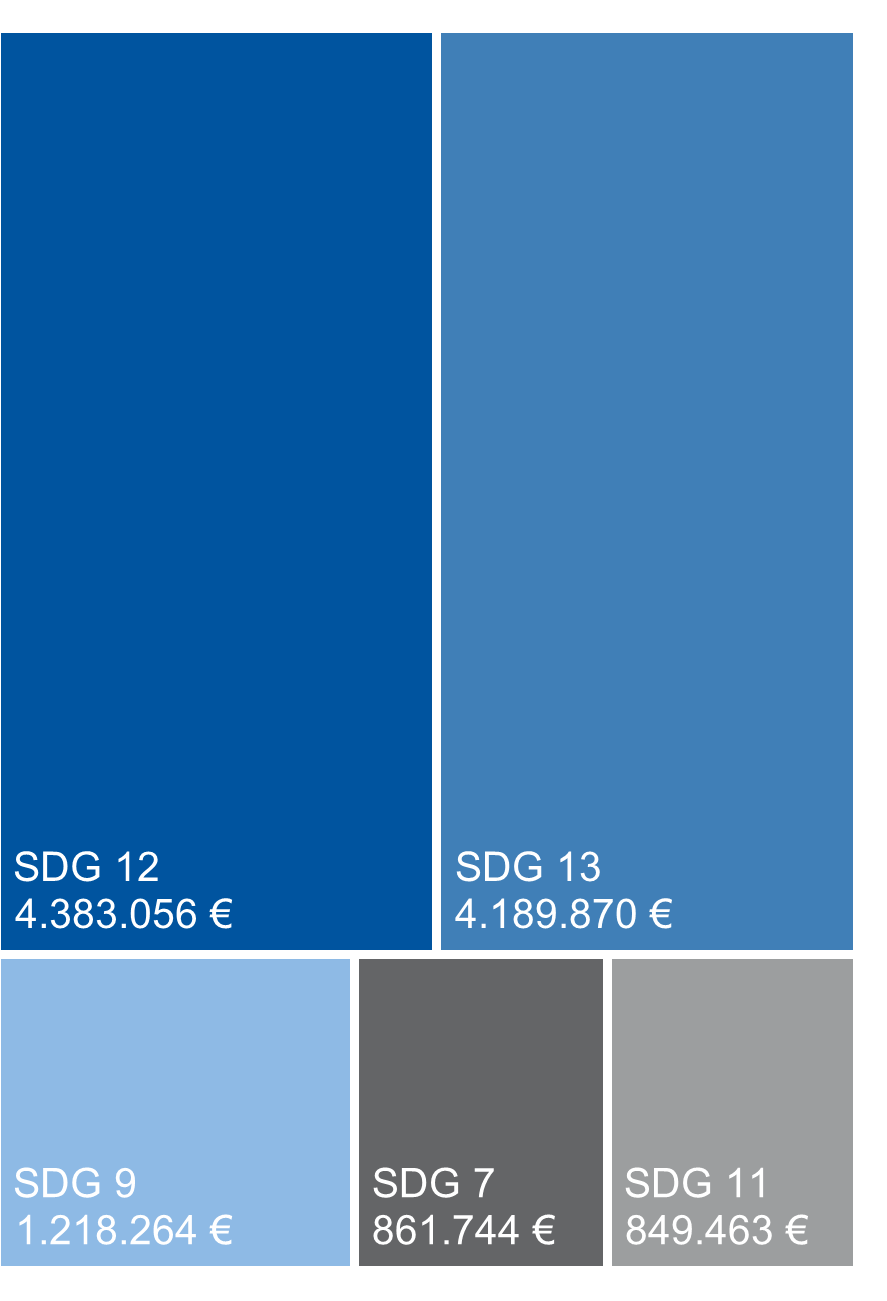
For 2024, third-party funding expenditures that can be linked to specific SDGs amount to a total volume of approximately €13 million, cumulative and excluding Faculty 10 – Medicine. SDG 12—Responsible Consumption and Production and SDG 13 – Climate Action stand out, each accounting for around €4 million in funding at RWTH (excluding Faculty 10). Funding between €800,000 and €1.2 million (RWTH-wide but excluding Faculty 10 – Medicine) was allocated to:
- SDG 7—Affordable and Clean Energy
- SDG 9—Industry, Innovation, and Infrastructure
- SDG 11—Sustainable Cities and Communities
Other SDGs account for smaller shares of funding. Integrating sustainability into third-party funding reporting directly supports one of the University’s core goals: building a reliable data foundation to capture and assess sustainability aspects in research projects.